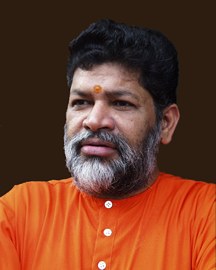
Swami Bodhananda on the times we live in and the places he has travelled — with the journals of those who travelled with him.
Swami Bodhananda — teacher of Vedanta and meditation, and founder of the Sambodh centres in India and the United States — writes here on the times we live in, the places he has travelled, the people he has known, and the wisdom of the Indian traditions. About Swami Bodhananda →
The one consciousness appears as all things. Could it also appear as a machine?
by Swami Bodhananda
Vedāntins often confuse four entities — the ego self, conditioned intentional consciousness, witnessing consciousness and pure consciousness. If consciousness is in every manifestation and is every manifestation, could a machine become conscious? An Advaita reflection.
There are three I-s — the body-mind ‘I’, the witness ‘I’ and the transcendental ‘I’ — and all are essentially the same Brahman. Like gold, a ring and a wedding ring, they are one stuff seen from different perspectives. Three I-s, one gold.
Advaita Ethics for the Machine Age — rethinking technological progress through Advaita
by Swami Bodhananda
Behind our search for better machines and material abundance lies a more fundamental aspiration: the pursuit of happiness. Advaita distinguishes viṣaya sukham, happiness sought through objects, from ātma sukham, happiness discovered in the self.
A machine may not need consciousness to act morally. It needs ethical direction, inclusive information and continuous learning — and the goal is a non-violent machine that can coexist and co-flourish with humanity.
The master–slave dynamic seems archetypal to human history. Geopolitics is static; power politics is dynamic. What Gurudev foresees, through Yoga Dṛṣṭi, for the next twenty-five years, from 2026 to 2051.
The source of the Second Axial Age will be the collective consciousness of global citizens — a networked and unified global self that feels and thinks for others. To exist is to globally coexist.
Karl Jaspers’ “Axial Age” — a pivotal shift in human consciousness between the eighth and third centuries BCE. Its achievements have come with a cost: are human beings on the brink of extinction, and is it time to think of a second axial age?
From the first fire and tools to industrial growth, humankind has tried to master nature. A reflection on why progress must now mean reconciliation with nature — to live with it rather than over it.
The 2024 parliamentary elections demonstrated the limits of the Hindutva ideology in holding on to power at the centre — a reading of India's electoral patterns, the idea of Akhanda Bharat, and the future of Indian democracy.
My mother was very dear to me, though I left her 45 years ago in search of God alone knows what… Gurudev's thoughts on the passing of his mother, 16 June 2015.
Thoughts on the new Prime Minister of India, on the day of the swearing-in
by Swami Bodhananda
Narendra Modi's stunning as well as sweeping victory in the general election to the 16th Parliament of India is epochal — thoughts on the day of his swearing-in.
Four ideas are competing for India's soul — the Gandhian, the Hindutva, the Secularist and the Romantic. A journey through the heart of India: Sevagram, Paunar, Deeksha Bhumi, the RSS headquarters, Pune and Ralegan Siddhi.
Management is the science of optimal utilization of material resources for human satisfaction. Yoga is the discipline of organizing human resources for individual fulfilment. Yoga and management are interchangeable words.
Dr K G Nayar is no more. For the last fifteen years he was my good friend, partner and guide — a pragmatic visionary who thought in prose but acted poetically.
Swami Bodhananda has often been described as a cool, ‘cutting-edge’ swami… An interview on Vedanta, Indian management, karma yoga and the goal of human life.
A roller-coaster pilgrimage to Kailash–Manasarovar, mostly driving off-road through the roof of the world — memoirs of the Mt Kailash–Manasarovar trip led by Sambodh Foundation, August 2010
by Swami Bodhananda
The yak is a symbol of sturdiness, steadiness and nimble footedness… Memoirs of the Kailash–Manasarovar pilgrimage led by Sambodh Foundation in August 2010.
The first “Hindu Dharma for the 21st Century” seminar, at the Sambodh Centre for Human Excellence, Kalamazoo — deliberations on the salient features of Hindu Dharma and how to share them with Hindu youth growing up in the United States.
Richard is no more. But that is only physically. His memories live on… here was a man who lived his life fully, righteously and spiritually, and left the world richer than he found it.
About the seminar “Indian Management for Global Effectiveness: Insights from the Mahabharata”
by Swami Bodhananda
A New Indian Renaissance is upon us. The purpose of this seminar is to develop a genuinely ‘Indian’ style of management, drawing on case studies from the Mahabharata.
Religion is old science and science is new religion. The final test of spirituality is not certainty about Truth or God, but our willingness to talk with each other respectfully.
King Shrutakirti of Avanti had a hundred wives but no son… A story of a grieving king, a sage, and a prince who has played the roles of sons and fathers in too many births to count.
An old lady loses her only son to a snakebite. The hunter wants to punish the snake — but the snake blames Yama, Yama blames Time, and Time blames karma…
Brahmachari Visvabandhu meditates for years and returns again and again to report his realisations — and each time his Guru sends him back to the forest…
Sambodh Foundation brings drinking water to a Himalayan village
by Swami Bodhananda
Drinking water is the primary need of human beings. Thoughts after inaugurating the Sambodh drinking-water project at Surya Gaon village, Sattal, in Nainital district.
Christianity, Europe and America are three spaces that intersect to create the concept of the ‘West’ — group uniqueness, individual freedom and humanism.
Management, a culturally determined discipline, exhibits flavours peculiar to the genius of the people. India has to integrate modern management values and practices with its age-old integral worldviews and human objectives.
On Sonia Gandhi's “renunciation” of the Prime Minister's post — a letter
by Swami Bodhananda
Nehru considered the Prime Minister's post a duty he was called upon to perform; Indira and Rajiv Gandhi took it as their privilege. How should we classify Sonia Gandhi's renunciation — like Rama's, Buddha's or Bhishma's?
On psychoanalysing Ramakrishna Paramahamsa — a letter
by Swami Bodhananda
I believe in the free expression of ideas with good conscience, and in a spirit of fearless enquiry. Arrogance is good, but humility is better; teaching is a privilege, but learning is a better privilege.
God and Human together create wealth, wellbeing and a just society. A focussed way to create wealth is the only way to self-renewal and the awakening of Kerala.
What lies at the heart of the debate on the cancellation of the Enron Dabhol Power Project? Only a market economy, directed by a democratic, secular polity, can lift 70 crore Indians out of poverty.